UX Researcher · Johannesburg and Cape Town

Designing with people at the center. Always.

I turn real human insights into clear, actionable improvements, bridging the gap between users, design, and product decisions.

3+
Years at Kandua
3
UX projects
7
Certifications
Thami Ndlela

Turning real human insights into products that actually work

I'm Thami, a UX Researcher driven by understanding the why behind user behaviour. I'm especially strong at turning messy, complex data into clear, actionable insights that help build intuitive, user-centred products grounded in real-world needs.

I completed my Higher Certificate in Web Design at the Academy of Digital Arts, where I also worked as a Teaching Assistant, supporting students and strengthening my foundation in design thinking.

Over the past 3+ years, I've worked as a freelancer with Kandua, growing from customer support to insurance claims handling and into leading UX research. This journey has given me a deep, practical understanding of how real users interact with digital platforms across different touchpoints.

More recently, I've been working with a leading African AI company, Lelapa AI, contributing to user-focused research that supports the development of more inclusive and accessible AI systems.

I'm working on deepening my practice in Human-Computer Interaction and I am open to opportunities, both remote and global, where I can continue learning, contributing and growing.

UX ResearchUsability TestingUser Interviews FigmaIllustratorPhotoshop Qualitative ResearchInsight Synthesis

Where I work and what I do

Feb 2024 to Present
UX Researcher (Part-time)
Kandua
Lead and conduct user research: interviews, usability testing, and validation studies to understand service provider needs on the platform. Translate findings into clear recommendations for product and design, and act as a consistent advocate for the user within the product development process.
Jan 2025 to Dec 2025
Teaching Assistant (Full-time)
Friends of Design, Academy of Digital Arts
Supported students and lecturers across digital learning platforms (Moodle, Teams, Zoom). Managed academic records, provided student support, and identified recurring challenges to improve systems and processes.
Feb 2023 to Jan 2024
B2B Claims Handler
Kandua
Managed end-to-end B2B claims during a high-growth phase following the onboarding of FNB. Identified recurring friction points and translated real-world challenges into actionable process improvements, recognised as a top-performing handler during this critical period.
Jan 2022 to Jan 2023
Customer Support and Research (Part-time)
Kandua
Provided support to service providers, gathered user feedback, and identified recurring pain points to inform product improvements. Built a strong foundation in user behaviour observation and insight gathering, the start of a natural transition into UX Research.

My work

UX Research · Kandua
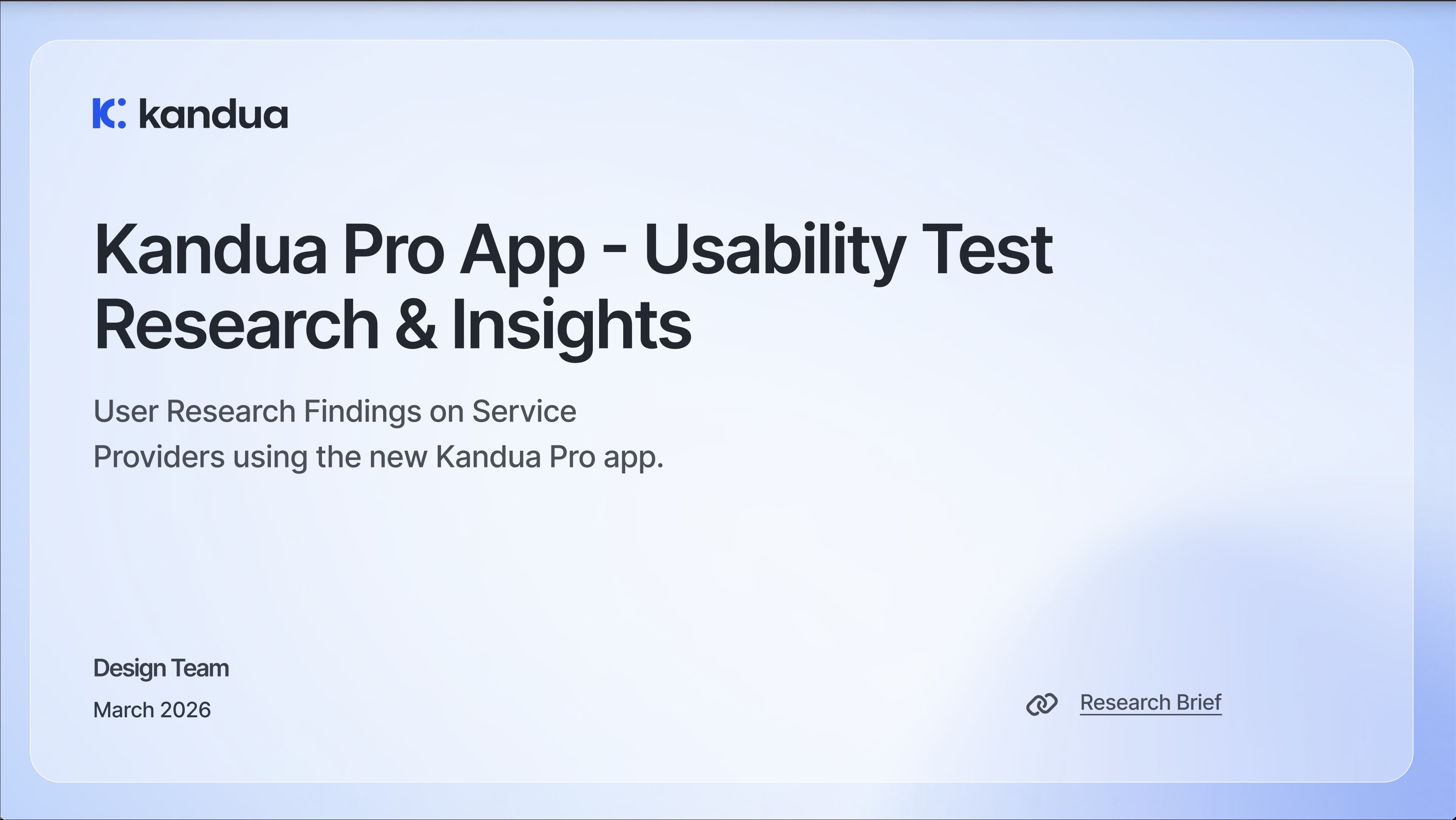
Kandua Pro App Usability Test
Moderated usability testing with 13 service providers on the redesigned Kandua Pro app, uncovering critical navigation and adoption friction points.
Usability TestingUser InterviewsMarch 2026
View Case Study →
UX Research · Kandua
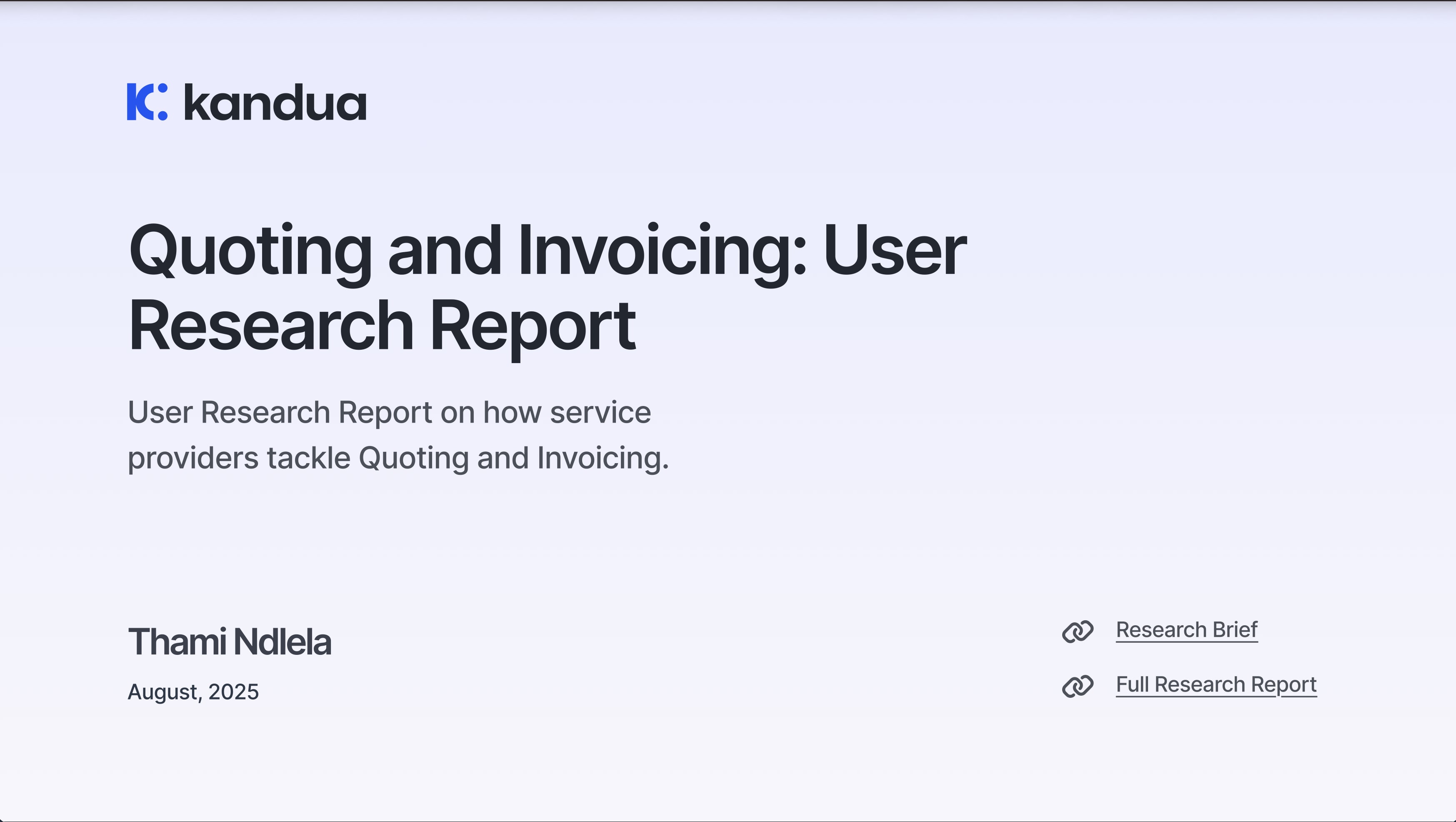
Quoting and Invoicing Pro Mental Models
In-depth interviews with 5 team-based service providers to map quoting and invoicing workflows, mental models, and pain points to inform a new product experience.
User InterviewsMental ModelsAugust 2025
View Case Study →
UX Design
WR2 Event Discovery App
Personalised event discovery platform integrating Spotify and Apple Music, with competitive analysis of South African platforms and a full UI design.
FigmaChatGPTCompetitive Analysis
View Case Study →
🔜
UX Research · Kandua
Conversational AI Homeowner Research
Research into how homeowners perceive, interact with, and trust conversational AI when posting home-service jobs online.
User InterviewsMental ModelsComing Soon
Case study in progress

What I bring to the table

Research Methods
  • User and Stakeholder Interviews
  • Usability Testing and Validation
  • Qualitative and Quantitative Research
  • Surveys and Screeners
  • Competitive Analysis
Analysis and Strategy
  • Insight Synthesis and Pattern ID
  • User Behaviour Analysis
  • Translating Research into Design
  • Journey Mapping and Personas
  • Stakeholder Presentation
Tools
  • Figma
  • FigJam
  • Adobe Illustrator
  • Adobe Photoshop
  • Google Forms / Canva
Soft Skills
  • Storytelling and Communication
  • Cross-functional Collaboration
  • Empathy-led Thinking
  • Client and Stakeholder Management
  • Iterative Problem Solving

Academic background

2025
Adobe Certified Professional
Graphic Design and Illustration using Adobe Illustrator · Academy of Digital Arts
2024
Higher Certificate in Web Design
Academy of Digital Arts · South Africa
2022
National Senior Certificate
Hatfield Online Christian School
🎨
Graphic Design and Illustration
Adobe Illustrator
🖼️
Visual Design
Adobe Photoshop
🎬
Video Design
Adobe Certified Professional
✨
Visual Effects and Motion Graphics
Adobe After Effects
🎥
Digital Video
Adobe Premiere

Let's work together

Open to new opportunities

I focus on UX research: understanding people, not just pixels. My work is rooted in asking the right questions, uncovering real behaviours and turning those insights into decisions that shape better, more intuitive products. I'm particularly interested in work where research is central, from user interviews and usability testing to synthesising insights that actually drive product direction. Currently open to full-time, contract and remote opportunities worldwide.

UX Research · Kandua · March 2026

Kandua Pro App Usability Test

Moderated usability testing with 13 service providers on the redesigned Kandua Pro app, identifying key friction points impacting adoption of critical features.

Role
UX Researcher
Participants
13 Service Providers
Methods
Moderated Usability Testing and User Interviews
Date
March 2026
Evaluating the redesigned Kandua Pro app

The Kandua Pro app was undergoing a redesign of its core job navigation system. The study focused on how service providers discover, differentiate, and manage various job types, specifically the new tabbed architecture separating Kandua jobs from Non-Kandua (private client) jobs.

The goal was to identify usability strengths and friction points that could impact adoption of critical features, and to produce insights that would inform product and design decisions across the team.

How the study was structured

A usability test guide was developed covering four primary focus areas: navigation hierarchy and entry points, tabbed job architecture, the transition from toggles to filters, and mental model clarity around terminology.

  • Pre-test interviews established participant background, trade type and existing Kandua usage habits
  • Structured tasks were designed for two distinct user types: Insurance Pros and Marketplace Pros
  • Tasks covered finding assigned jobs, filtering by partner, toggling job states and creating private Non-Kandua jobs
  • Post-test interviews explored mental models, navigation feel, terminology confusion and unmet expectations
  • Success was measured across navigation, entry point clarity, tab usage, filtering, terminology and task completion
Core navigation is largely intuitive, but the job model does not always match how Pros think

Most service providers navigated the app's primary flows with little difficulty. However, a clear mental model mismatch emerged around Non-Kandua jobs. For many Pros, private client work typically begins with capturing customer details or sending a quote, not "creating a job." The app's entry point reflected the system's logic rather than the Pro's real-world process.

Visibility
The Non-Kandua tab did not look interactive. Its design resembled a page header rather than a tappable tab, causing many Pros to miss it entirely.
Adoption
Because Pros did not notice the Non-Kandua tab, they never looked for it and continued managing private client work outside the app.
Habit
Many Pros expressed a stronger preference for insurance work because it felt more predictable and structured compared to managing private jobs through a new system.
"Upcoming Jobs" created confusion on the homepage

Several participants were unsure what kind of jobs the Upcoming Jobs section was showing. Marketplace Pros were unsure whether these were new opportunities or already-accepted jobs. Insurance Pros were uncertain whether jobs shown were newly assigned, accepted, or requiring urgent action. The abstract label created unnecessary friction on a screen where clarity should be immediate.

What we proposed to the product and design team
  • Introduce lightweight onboarding and in-context education around Non-Kandua jobs through tooltips, contextual prompts and empty-state guidance
  • Reframe the Non-Kandua tab visually so it reads as an interactive element rather than a section header
  • Position the Pro app as a business-management tool, not just a Kandua job tool, by embedding private client workflows as a core part of the experience
  • Add brief explainer text or tooltip guidance beneath the "Upcoming Jobs" header to clarify what types of jobs are shown
  • Align terminology with the language Pros already use: assigned, accepted, scheduled and needs action
UX Research · Kandua · August 2025

Quoting and Invoicing Pro Mental Models

In-depth interviews with team-based service providers to understand how Pros approach quoting and invoicing, map their workflows, and surface opportunities for a more intuitive product experience.

Role
UX Researcher
Participants
5 Team-based Pros
Methods
In-depth Interviews, Workflow Mapping
Date
August 2025
Understanding how Pros actually quote and invoice

The goal was to understand how service providers currently approach quoting and invoicing, the mental models they use, and the challenges they face, so the team could design an intuitive quoting and invoicing experience that felt natural for any Pro to adopt.

The challenge going in was that workflows vary widely. Solo Pros tend to use pen and paper or simple tools, while team-based Pros use platforms like Sage, Excel, and QuickBooks. Understanding these differences was essential before designing a single unified solution.

How the interviews were structured

Five in-depth interviews were conducted with team-based service providers across different trades. Sessions ran 45 to 60 minutes each and were structured across three phases: biography and context, problem exploration without priming on quoting, and a deep dive into quoting and invoicing workflows.

  • Biography session established trade type, team size, job volume and customer profile
  • Problem exploration surfaced day-to-day challenges in participants' own words, without leading them toward quoting
  • Deep dive covered the full quoting and invoicing sequence, tools used, deposit practices, VAT and markup handling and what happens when things go wrong
  • Cross-interview synthesis was used to identify patterns, gaps and design opportunities
Pros follow a consistent workflow but have a strict mental model separating quotes from invoices

Across all participants, the workflow followed a clear sequence: site visit, formal written quote, deposit request, work completion, invoice for remaining balance, and final payment. The distinction between a quote (provisional) and an invoice (final) was firm and consistent across all Pros.

Quote first
Pros always quote before work begins. Although they may give rough on-site estimates, formal written quotes are prepared later and sent via their preferred tool.
Deposits
Deposits of 50% are standard for jobs above a threshold (typically R5k to R20k). They are essential for cash flow and covering materials before work starts.
Invoice from quote
Invoices are almost always generated directly from the original quote, with any extras added at the end. Pros want one streamlined flow, not separate documents.
Scope creep
Clients frequently request extras mid-job. Pros re-quote for these additions, but the process is often informal and creates admin burden.
Pain points come from clients, not the tools

Notably, no major pain points emerged around the quoting and invoicing tools themselves. Team-based Pros have already embedded systems that fit their workflows and expressed little need for an alternative. The real friction points were behavioural, not technical.

  • Quote rejection is common due to price sensitivity, with clients using quotes to shop around with competitors
  • Late payment is normalised and treated as a recurring risk that Pros manage through manual follow-up via WhatsApp, email and calls
  • Deposit enforcement is inconsistent, with some clients resisting deposits and forcing Pros to negotiate terms before work can begin
  • VAT application is inconsistent across Pros, with some building it into quotes and others adding it at the invoicing stage
Adoption of new tools requires clear value and easy onboarding

Pros with teams are already invested in systems like Sage and QuickBooks. They will resist switching unless the new tool integrates easily, is at least as reliable, or offers clear time or cost savings. Initial resistance to digital tools was noted, pointing to a need for onboarding and training support built into any new product experience.

Design principles for the quoting and invoicing experience
  • Support a seamless quote-to-invoice conversion flow so Pros are not duplicating work across documents
  • Build clear deposit request workflows into the product, including threshold-based prompts
  • Include client-facing transparency features such as itemised line items and compliance notes to reduce quote disputes
  • Design for the team-based approval flow where one person prepares, a manager reviews and then the quote is sent
  • Next steps should include interviews with solo Pros in Cape Town and Johannesburg and gathering the homeowner perspective on receiving and responding to quotes
UX Design

WR2 Event Discovery App

A personalised event discovery platform that connects to users' Spotify and Apple Music profiles to recommend events aligned to their musical taste.

Role
UX Designer
Duration
5 Days
Tools
Figma, ChatGPT
Methods
Competitive Analysis
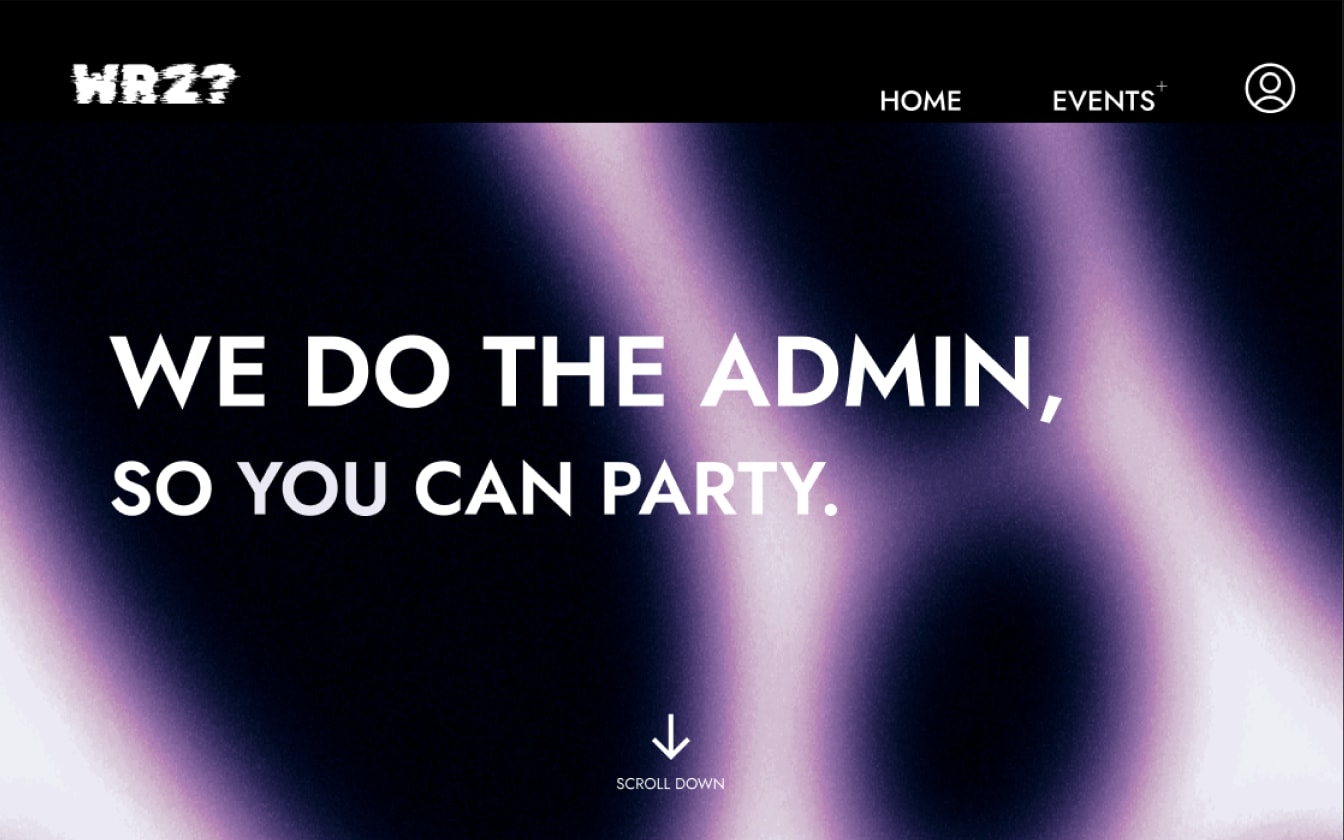
We do the admin, so you can party

WR2 is an application designed to help users discover events in their city, tailored to their taste by integrating their Apple Music and Spotify preferences. The platform fills a clear gap in the South African event discovery market where personalisation is absent.

Mapping the competitive landscape

A competitive analysis of the top event platforms in South Africa was conducted, covering XCEED, Howler, and Quicket. The analysis identified a consistent gap across all three platforms.

  • All three platforms allow ticket purchasing but none offer personalised event recommendations
  • No platform connects to a user's streaming profile to understand their music taste
  • The opportunity was clear: build a discovery layer driven by what users already listen to
The gap worth filling
01
Users want events recommended based on artists and genres they already love, not generic listings.
02
Connecting to an existing streaming profile reduces onboarding friction significantly.
03
Category-based browsing (Nightlife, Festival, Comedy, Live Band) improves discoverability for all users.
04
Showing top artists from a user's profile alongside matching events creates a genuinely personal feel.
The WR2 interface

The final UI features a dark, atmospheric design with "Popular in South Africa" and "Based on Your Preferences" event sections, a category filter system, individual event detail pages with ticketing, and a taste-profile view showing top artists and matched events by genre.